⊹ 𝐍𝐚𝐦𝐞:
Leslie Emerson.
⊹ 𝐀𝐠𝐞:
Twenty-four.
⊹ 𝐏𝐞𝐫𝐬𝐨𝐧𝐚𝐥𝐢𝐭𝐲:
Most of the time, people no longer knew which version of Leslie they were going to get. He had a way of keeping everyone slightly off-balance, himself included. At his worst, he was reckless and volatile, always one word away from splintering open. He could be selfish in his greed, hungry in ways that were not always easy to name. Affection, attention, escape, oblivion—he wanted it all, and with an intensity that could be almost frightening. He could go cold without warning, lash out, withdraw, or turn cruel in the span of a breath if he felt cornered, disappointed, or looked at too closely.
Most of his ugliest instincts were defensive. He had been hurt enough to understand the difference between safety and the illusion of it. So he protected himself with distance, with appetite, with meanness, with silence. It was easier to make himself difficult to reach than to risk being known at all.
At his best, Leslie was charismatic without seeming to try. He had an effortless charm about him, a way of looking at people that made them feel briefly illuminated, as though for a moment they had been picked out from the rest of the world. His eyes were open and honest when he spoke to the elders at church, his manner so sincere it was easy to mistake him for softer than he was. Leslie was good at that—pretending. Even when he looked untouched, even when he was laughing, even when he was beautiful and bright enough to fool people into thinking he was fine, everything inside of him ached. That was the truest thing about him.
⊹ 𝐀𝐩𝐩𝐞𝐚𝐫𝐚𝐧𝐜𝐞:
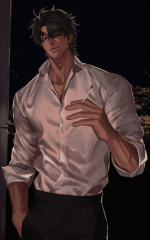
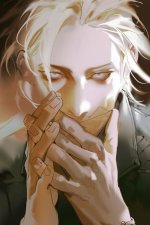
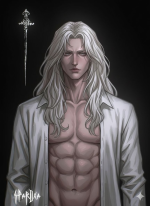
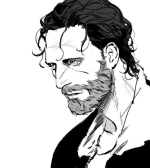
Leslie stood around 5'11", all long lines and restless angles, lanky at first glance, though wiry muscle ran beneath the frame from years of taking whatever work he could get around town. His hair fell in messy, layered waves, dark blue threaded with pale blond at the crown, giving him a storm-touched look that made his pale skin seem starker by contrast. His features were fine and angular, with heavy-lidded eyes, a straight nose, and a soft, tired mouth. Dark ink climbed over his arms and collarbones in a scattered collection of small, scratchy designs—stick-and-poke stars, a cross, bits of script, a few half-faded shapes that looked more impulsive than planned. His hands were rougher than the rest of him, knuckles nicked, nails painted black and chipped down at the edges. His eyes were pale blue, though never soft—there was always something dark pacing behind his gaze, something almost reptilian. Even standing still, he never looked fully at ease in his own body.
⊹ 𝐁𝐚𝐜𝐤𝐠𝐫𝐨𝐮𝐧𝐝:
The house on Shepherd Lane looked ordinary enough. White shutters gleamed with fresh paint. The lawn was clipped. The mailbox never overflowed. Inside, the Emersons sat at a long oak table, set for three. Leslie’s mother, Elora, carried the conversation, chewing her way through small talk, smothering the grief muzzled in her throat. Leslie’s father, Rowan, had a black-eyed gaze; whenever Elora smiled his way, his eyes dropped to the floor. He mumbled when she asked about his day, left half her dinner untouched, and glued himself to the flickering light of the Sunday soccer games.
At some point in Leslie’s childhood—he couldn’t remember when—she had looked at his father with stars in her eyes. My love, she'd say. Her savior, she must have thought—the man who had brought her a semblance of a family. Now, she sat small in her lavender sweater, pale fingers caught in the yarn. Each time his father’s hand swept across the table, she folded inward, paper worn thin by too many creases. It was easy for Leslie to hate her; the feeling became as natural as breathing.
Whenever Leslie spoke to the elders at church, their eyes skimmed past the bruises darkening his jawline. They rehearsed the same future: doctor, wife, house. They called it a kindness. Leslie only smiled when they spoke, and quietly hoped they’d be buried long before he had the chance to disappoint them. He didn't cry, and maybe that was strange; instead, he folded his mother's clothes into tight, little squares and fit them into two suitcases. Leslie’s mother never questioned why he did it. And Leslie never questioned why she hid the suitcase underneath her bed.
In the present, he only belonged to memories, and not in a gentle way. Not in the way that reminded him of soap and cigarettes and bone-deep, aching familiarity—Renly. For a while, they were inseparable. Renly was never just a desire to him; he was something softer, stranger, beautiful. Leslie wanted him in the way of flesh wanting to knit itself together over a wound. After Renly left for Northbridge, he was too exhausted to cry, or to hate himself for wanting to. Eventually, he stopped writing Renly’s name in the margins of notebooks, receipts, church bulletins. Stopped reaching for him in all the small, humiliating ways.