Identity
Name: Aveline Rillstone
Nickname: Bluebell, Rillstone Jewel
Reason: Her blue eyes are often compared to the famous Rillstone sapphires
Gender: Female
Orientation: Queer
Appearance
Age: 22
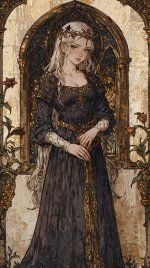
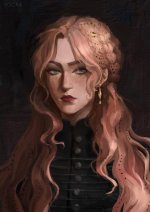
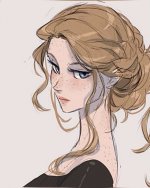
Hair: Dirty Blonde; down to her mid-back
Eyes: Ocean blue eyes
Height: 5’2
Weight: 120 lbs
Dominant Hand: Right
Background
Hometown: Rillstone Vale; a coastal mountain region where sapphire mines sit high in the cliffs
Cultural Heritage: Berlowan high nobility, though the Rillstones are considered “new money” among aristocracy
Background:
The Rillstone family had not always been wealthy. Only two generations earlier they had been little more than a poor and forgettable household, one of the many scattered through the mountain valleys. Their fortune changed almost overnight when miners uncovered one of the largest gemstone deposits in the region. Deep within the mountain caverns lay veins of brilliant sapphires, stones so pure and plentiful that nobles across the country soon sought them. With those stones came wealth, influence, and the sudden rise of the Rillstone name among the upper class.
When Aveline was born, she came into the world with eyes the color of those same sapphires. The striking blue never faded as she grew; if anything, their brightness only deepened with time. It became a small legend within the household. Servants and visitors alike began calling her the Rillstone Gem, the sapphire in the mountains. Wherever she went, people compared her eyes to the precious stones that had built her family’s fortune. Rarely did anyone notice how often her gaze wandered toward the sea that glittered far below the valley.
Aveline was the second of three children born to her parents. Her elder brother, Augustus, had been born healthy and was once expected to inherit everything the family had built. But when he was still young, a carriage accident left him permanently confined to a wheelchair. In the eyes of their parents and the society that surrounded them he was no longer considered a suitable heir.
Soon after, Aveline was born. For a time, her parents hoped she might still serve their ambitions through a strategic marriage. But a daughter alone could not guarantee the future of their newly risen house. Determined to secure a proper male heir, her mother endured another pregnancy not long after. Aveline’s younger brother, Cyrus, arrived healthy and strong, and from that moment forward he became the center of the household’s attention.
Cyrus was watched constantly, guarded with a near suffocating protectiveness. The family’s future rested squarely on his shoulders, and even as a child he was burdened with endless lessons in etiquette, responsibility, noble conduct. Aveline could see the pressure placed upon him, the expectations that weighed heavily on someone so young. In her eyes, he carried perhaps the greatest burden of them all.
Yet while Cyrus was molded into the family’s future, Augustus was quietly removed from it. He spent most of his days within the estate, rarely seen by society and largely hidden from public gatherings. Though he had attendants to care for him, his world grew smaller with each passing year.
Aveling, meanwhile, drifted somewhere between. Like Augustus, she was largely overlooked. But unlike him, she had no dedicated staff or structured role within the household. Her parents’ focus was fixed firmly on Cyrus and whatever attention remained was often consumed by the growing responsibilities that came with managing their newfound fortune. The neglect gnawed at her.
At first it appeared as small acts of rebellion, but over time those acts grew bolder. Aveling spoke out of turn at dinners, interrupts conversations, and openly challenged tutors and other adults alike. She tore flowers from the gardens, ruined her mother’s dresses, and lashed out at her younger brother in flashes of jealousy she later hated herself for feeling. Punishments came quickly. New tutors, stricter rules, harsher reprimands, but none of it seemed to truly change her behavior.
Eventually, Aveline’s parents assigned her a lady-in-waiting, in the hopes she would mellow out the rowdy noblewoman. The girl was meant to serve as both companion and chaperone, someone who could occupy Aveline’s restless energy while guiding her toward proper conduct. In many noble households it was a common arrangement, almost like providing a build-in friend. For Aveline, it became something far more important than anyone had intended.
It was something different and entirely alien. Their bond formed quickly and deeply. It made her skin prickle with gooseflesh, and her nerves sensitive to every wisp of the wind. Her blood would boil at the oddest of times and the joy overflowed from her like a blessed summertime spring. The days seemed endless and the nights entirely dauntless. Fear was but a flicker of a flame deep in the depths of her mind. No longer was she Aveline Rillstone– she was simply Aveline. She was a girl who enjoyed the sun and warm weather, who was fascinated collecting seashells and feeling sand between her toes. A girl who adored the aching feeling in her shoulders from swimming too long in the rampaging depths of the sea. A girl who loved the satisfaction in her friend’s tone when she approved of the newest conch to add to the collection. A girl who loved the way the sun never seemed to burn, but only deepened and beautified her companion’s features, to make her seem more grown. A girl who loved to sit until the early hours of the morning, whispering lines from her book of fairy tales as if the pages full of adventures and freedom harbored the secrets of escape for the pair from the realities of their lives.
Aveline’s episodes had been somewhat contained, though not entirely snuffed, for how could they expect the weight of a youth’s entire childhood support system to fall upon the shoulders of a young girl barely learning the ways of noble society herself? So when Aveline continued to act out, when she decided to ruin her mother’s dresses, to cut all the roses from the bushes, to refuse to eat for almost 10 days straight, the head of the household decided the problem must be the servant girl. Who else could have any influence over the young noblewoman?
It was Aveline’s fault, really. At least, this is what she had been told by her parents. The next morning another girl had shown in her friend’s place. All the staff would say to the young lady was to talk to her father. When she finally talked with him, he simply explained he knew that Aveline’s friend was the root behind her outbursts, so he weeded out the problem. It wasn’t for another five days until Aveline could manage to run from the estate to the house of the lady-in-waiting, desperate to apologize and mend any semblance of their relationship that was. She turned up to the house to find her friend had been sold off two days prior.
From then, what could Aveline do but obediently obey her parents’ wishes? They were her only form of support left in her dwindling world, what with her guiding light being snuffed out. Would they take her matronly nanny away next? Perhaps her older brother, the one she could confide in when the walls of the estate closed in too close and Aveline felt as if she couldn’t breathe. What of her newfound friends she only just made at her teaparty? Nothing and no one felt safe if she took a misstep.
So Aveline chose to make no more mistakes.
Though it was a choice much easier said than done. Foolishly she believed she could simply snuff her emotions and wear a stone mask, that she could handle any onslaught of slights against her. Old habits truly die hard.
Aveline in her teen years was sent away to an academy for more formal training. She had grown up by the sea. Most of her happiest childhood memories were spent on the private beach, where the smell of seasalt was second nature to her. She had a collection of conches she built over the years. She always had a fascination with the way a creature could build this sturdy structure as if by magic. A home, custom made, and protected from the world. The shells now collected dust on her shelves, each conch a stagnant memory of when she could find a pure joy.
Deep into the mountains she went. There was no beach nor pond or lake alike that she could find among the dense forests that surrounded the academy and its town. A river flowed along the eastern edge and there Aveline could find some reminder of her home. She would spend her free days there, staring at the running water, and wondering how far it flowed before reaching the great sea she ached for.
The young noblewoman wrote letters almost daily to her family. She cried to Augustus of how lonely she felt here, how strict and scornful the watching eyes of the mentors were. How they seemed to suck the happiness from every soul that walked through the stone archway. She pleaded with her mother to talk to her father. She desperately attempted to convince her father that she was indeed improving and fit to return. Once or twice, Aveline had even written to her younger brother, regrettably so for fear of adding more pressure to his shoulders.
When she had finally received a letter in return from her father, Aveline thought her hopes had been answered finally. She remembered laughing when she read the contents. It was the first time he had written since she had left home, and indeed he was giving her a way to return… in exchange for her betrothal to Royal Duke Alden.
The Kingdom of Berlow was a month’s journey across the sea, under prime conditions. Royal Duke Alden is cousin to the prince, who was destined to take over the throne within a few years. Rumors told of Alden being a strict ruler and man alike, and has already been wed twice where women have died in strange circumstances. One had supposedly locked herself in one of the dungeons, accidentally, when foolishly exploring on her own. Some say it was no accident: that she was found chained. But the man was wealthy beyond imagination, almost paralleling the royal family’s fortune.
Aveline could not remember much from her time at the academy once she had left. The memories were foggy and confusing, a blurred mush of stories that didn’t want to be told. She knew she didn’t want to return, though she didn’t wish to wed the Duke either, so she hoped she could convince her father when she returned. She did not wish to trade one prison for another.
Skills
Professional Qualifications: trained in high-class etiquette and culture,
Talents: playing the rebec, public speaking
Skills: gambling (hazard in particular), swimming, conversational persuasion
Qualities
Personality:
Aveline is, at first glance, exactly what a noblewoman is expected to be. She appears poised, pleasant, and endlessly agreeable. She has mastered the art of making others comfortable in her presence. She can be warm and attentive during conversation. Many people leave interactions with her feeling charmed and understood. Years of etiquette training and emotional survival at the academy have made her highly perceptive of other people’s moods, allowing her to adapt herself easily to the expectations of whoever stands before her.
Beneath that polished exterior Aveline carries a restless and passionate heart. She feels things intensely, even if she works to hide it. Her childhood was marked by bursts of rebellion and emotion born from loneliness and a desperate need to be noticed. Although she has since learned to restrain the impulses, the fiery core still exists within her.
Despite a newfound disciplined persona she presents to the world, Aveline harbors a quiet longing for freedom and authenticity. She envies people who can speak their minds without fear and make choices for themselves without worrying of family expectations or social consequences. At her core, she is someone caught between two identities. One is the dutiful daughter who has the respect of her family. The other is the spirited young woman who dreams of music and travel and the feeling of sand beneath her feet.
Strengths: passionate, charismatic, persuasive, emotionally perceptive, resilient
Weaknesses: impulsive, idealistic, prone to internalizing guilt, sensitive to rejection
Likes: seashells, beaches, sunshine, heat, summer, reading, singing, music, the scent of sea salt, ocean breezes
Dislikes: being ignored, embroidery, cold climates, being locked up
Hobbies: swimming, exploring nature, researching/learning, collecting shells, practicing music
Fears: abandonment, loss of all freedom, becoming trapped again
Secrets: Aveline would love to be traveling in a musical troupe performing for others.
Desires
Primary Yearning: Freedom to live her life without being under the control of her father.
Goals: Gain her freedom while maintaining a relationship with her family.
Wishes: To see the wider world, explore the music, food, and experiences other cultures could offer.
Family
Parent 1: Viscount Edmund Rillstone – ambitious and pragmatic, determined to secure the family’s place in high society for generations to come.
Parent 2: Viscountess Marianne Rillstone – strict, socially calculating, quietly resentful of her life.
Siblings:
Cyrus Rillstone – younger brother and current heir. Raised under intense pressure to carry the family legacy. Sheltered and watched constantly.
Augustus Rillstone – elder brother. Thoughtful and gentle, confined to a wheelchair after a carriage accident in childhood. He and Aveline share a quiet understanding and often confide in each other.