



- Local time
- Today 9:54 AM
- Messages
- 358
- Pronouns
- she/her

City of Bakhroma
Location:
Country of Morvany
Year:
Late 1800s
Setting the Scene:
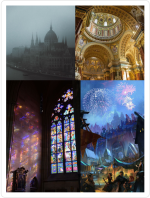
Bakhroma is a city still in the middle of becoming itself. It was never built as one unified place, but as layers stacked over time; old districts, newer imperial expansions, and civic projects laid over whatever was already there. Even now, it doesn’t feel like a single city so much as several stitched together, some parts carefully maintained, others left to slowly fall apart. It is culturally rich and architecturally striking, but also layered with social tension, superstition, and hidden systems of power. Magic is woven into its very foundations; it exists as part of infrastructure, daily life, and political control, treated as both tool and threat depending on who is using it.

Magic System
Magic exists on a spectrum and comes with cost depending on scale and use.
Small-scale magic is normalised and publicly accessible in tightly regulated forms. These include enchanted household objects (self-boiling teapots, warming charms, protective wards), simple runic workings, and utility-based enchantments. These forms are widely used in everyday life and do not typically carry significant cost.
Mid-tier magic exists in a more dangerous, less regulated space. This is where independent practitioners, including Sevani travelling groups, operate. Their magic is more personal and can carry increasing costs depending on strength, intent, and frequency of use.
High magic is restricted to the nobility and sanctioned institutions. It is controlled, politically protected, and often tied to systems of governance and enforcement. This level of magic may involve significant external costs, including drawn energy from environments, animals, or unwilling subjects.
If no external source is available, magic begins to consume the caster instead, manifesting as physical deterioration, illness, or long-term bodily damage.
Magic itself is not a single finite resource, but something more fundamental, like energy. It exists everywhere, but requires knowledge, discipline, and structure to wield.

The Nobility
Magic is traditionally associated with noble bloodlines. Generations of magical families have used it to consolidate power, influence governance, and maintain control over society. The public has largely been taught that nobility are the only ones capable of responsibly handling magic, and that their role is to protect the common people from its dangers. However, this system creates deep inequality. The nobility control the most powerful forms of magic, while also shaping the rules that govern its use. This reinforces both dependence and resentment within the wider population.

The Order
The Order is the city’s enforcement body responsible for regulating magic use and maintaining public order.
Their role is officially protective, but in practice they function as an extension of noble authority. They regulate magic, suppress unlicensed use, and intervene in politically sensitive situations, often reinforcing existing social hierarchies rather than neutralising them.

The Anti-Magic Movement
A growing ideological movement that believes all magic should be abolished entirely, including noble and sanctioned forms.
It begins as a small group of fanatics preaching in the streets, blaming magic for societal corruption, inequality, and suffering. Over time, it grows into a structured, influential movement with real political weight.
At its core is a charismatic leader:
A powerful public speaker.
Emotionally persuasive and deeply convincing.
Able to make people feel seen and heard.
Privately from a fallen or disgraced noble family.
The movement spreads through emotionally charged rhetoric and a strong “us versus them” framework. Ironically, many followers justify contradictions in the leader’s identity, believing they are “different” or “better” than other nobles.
The Order actively is trying to suppress this movement.

Core Political Tension
The nobility believe they are maintaining stability and preventing chaos by controlling magic.
The anti-magic movement believes magic is the root of all corruption and must be eradicated.
The Order enforces the system but also reinforces its inequalities.
Independent magic users (mainly the Sevani) exist outside all formal structures, challenging both authority and legitimacy.

Potential Consequences?? (if magic WAS to collapse)
Magic is deeply embedded in Bakhroma’s infrastructure, including:
Transport and construction.
Food production.
Healing.
Protection against larger supernatural or environmental threats.
Because of this, any attempt to fully abolish magic would not be immediate. Even if noble systems collapsed and magical artifacts were destroyed, society would destabilise significantly.
A sudden removal of magic would likely cause:
Infrastructure breakdown.
Food shortages.
Medical crises.
Vulnerability to external threats.
The anti-magic movement accelerates an already unstable system rather than resolving it.
